How to Track Competitor Mentions in AI Answers
When a potential customer asks ChatGPT which tool they should use for your category, the answer they get is shaping their decision before they visit a single website. If a competitor is named in that answer and you are not, the competitive gap is real even if it never shows up in your rank tracker.
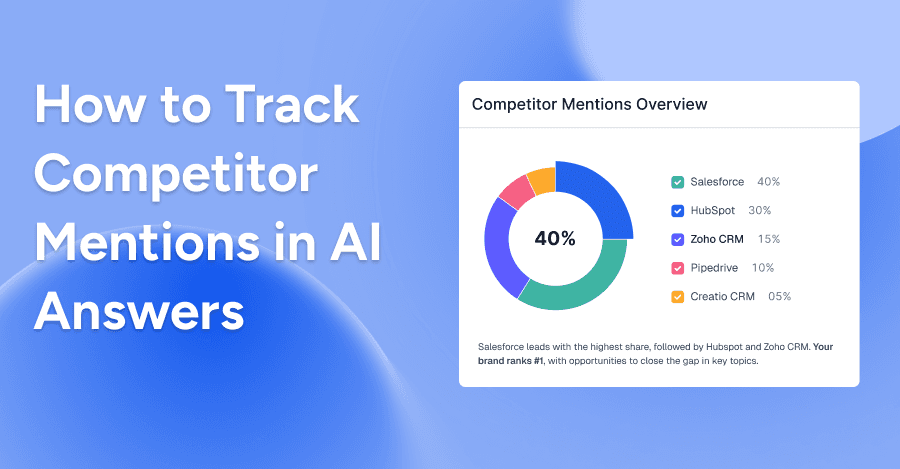
Tracking competitor mentions in AI answers is a relatively new practice, but it is becoming a core part of competitive intelligence for marketing teams that sell in categories where AI search is active.
AI Competitive Intelligence vs Traditional SEO Monitoring
Factor | Traditional SEO Monitoring | AI Competitive Tracking |
What you track | Keyword rankings per page | Brand mentions per prompt |
Output format | Position 1–100 in SERP | Named or not named in prose |
Competitor metric | Rank comparison | Share of voice in AI answers |
Sentiment data | Not available | Positive / neutral / cautionary |
Citation source | Backlink analysis | Which publication is cited by AI |
Varies by engine | Minor differences | Significant differences per engine |
Update speed | Days to weeks | Can change within hours |
What to track
Share of voice in AI responses
For any given set of prompts relevant to your category, how often does each competitor get mentioned compared to your brand? A competitor appearing in 70 percent of category-relevant prompts while you appear in 20 percent has a significant structural advantage with AI-assisted buyers.
Example — share of voice audit
25 prompts run across ChatGPT and Perplexity. Category: marketing attribution tools.
Brand A (market leader): 22/25 prompts = 88% visibility
Brand B (their competitor): 18/25 prompts = 72% visibility
Their brand: 6/25 prompts = 24% visibility
Brand C (newer entrant): 9/25 prompts = 36% visibility
Key finding: a newer competitor beats them in AI visibility.
Investigation: Brand C has 40+ G2 reviews and two recent TechCrunch mentions.
Their brand: 6 G2 reviews, no press.
Action: external PR and review generation campaign.
Position within the response
The brand named first, or mentioned earliest in a paragraph, generally receives more weight from the reader. Tracking whether competitors consistently appear before or after your brand reveals positioning dynamics invisible in standard SEO reports.
Sentiment of the mention
Not all mentions are equal. A competitor described as a well-established leader is a very different signal from one described as a popular option, though some users find it complex. Sentiment distinctions reveal whether a strong mention count is translating into persuasive recommendations.
Citation and link patterns
Perplexity and Google AI Overviews cite sources alongside answers. If a competitor is consistently cited from a particular publication or review site, that source is driving their AI visibility. Knowing this tells you where to build your own external presence.
Engine-by-engine variation
ChatGPT, Perplexity, Gemini, and Claude do not produce identical answers. A competitor might dominate on Perplexity but appear rarely on Gemini. Tracking across engines gives a complete picture of where competitors are winning and where gaps exist.
How to run the tracking
Build your prompt library
Practical exercise — build your first prompt library in 30 minutes
Step 1: Write down the 5 questions your sales team gets asked most on discovery calls.
These are your highest-value prompts.
Step 2: Add 3 comparison prompts:
- 'Best alternatives to [top competitor]'
- '[Your category] tools for [your target customer type]'
- 'How does [Competitor A] compare to [Competitor B]'
Step 3: Add 2 problem-based prompts:
- 'How do I solve [main problem you fix]'
- 'What software helps with [use case]'
Step 4: Run all 10 prompts in ChatGPT and Perplexity.
Record every brand mentioned. Count mentions per brand.
You now have a baseline share of voice report.
Run the same prompts again in 4 weeks to see what has changed.
Run prompts consistently and repeatedly
AI answers are not static. Running each prompt once gives a snapshot. Running the same prompts weekly across the same engines gives a trend. Trends are what allow you to detect when a competitor has made moves that are changing how AI engines represent them.
Use a dedicated AEO monitoring tool
Manual tracking works for initial exploration but becomes difficult to sustain. Platforms built for AI visibility monitoring automate prompt execution, response capture, and analysis, and present results in dashboards that make competitive trends easier to interpret.
What to do with what you find
Identify which competitors have an AI presence you do not
If a competitor appears consistently in prompts where you do not, investigate why. Look at what external sources are naming them. Check whether they have content that directly answers the prompts you are tracking. Understanding the source of their AI visibility tells you what to build.
Find prompts where no competitor dominates
In most categories, AI coverage is uneven. There will be prompt types where every major competitor appears regularly, and others where responses are thin. The second group is the biggest opportunity — if you build authoritative content around those prompts before competitors do, you establish a lead that is difficult to displace.
Monitor for sudden changes
A competitor who suddenly increases their AI presence may have launched a content campaign, received significant press, or been listed in a major publication. Catching this early allows you to respond while the gap is still small.
The competitive case for starting now
Most marketing teams are not yet systematically tracking their AI competitive presence. The teams that start now are building a data advantage that compounds over time. By the time AI competitive tracking becomes standard practice, the brands doing it today will have the knowledge and content infrastructure to maintain a significant lead.
Summary
Tracking competitor mentions in AI answers helps you understand which brands are being recommended to potential customers across ChatGPT, Perplexity, Gemini, and other AI-powered search experiences.
Unlike traditional SEO tracking, AI competitive monitoring focuses on brand mentions inside generated answers, share of voice across prompts, sentiment, citation sources, and how competitors are positioned relative to your brand.
By running a consistent set of category-relevant prompts, recording which brands appear, and reviewing changes over time, teams can identify competitive gaps, uncover content opportunities, and understand where competitors are winning visibility in AI search.
As AI search becomes a bigger part of how buyers research products, tracking competitor AI mentions is becoming a core part of modern competitive intelligence.
Frequently Asked Questions
How do I find out if competitors appear in ChatGPT more than my brand?
Run 10 to 20 prompts relevant to your category across ChatGPT and Perplexity. Record every brand mentioned in each response and count how often each appears. This gives you a baseline share of voice comparison. For ongoing tracking, a dedicated AEO monitoring tool automates this process daily.
What should I do if a competitor is mentioned more often in AI answers?
First, identify why. Check their third-party presence: reviews on G2 or Capterra, press coverage, community mentions. Then check their content — do they have pages that directly answer the prompts where they appear? Use this to identify specific gaps in your own presence and address them.
How many prompts do I need to track competitors effectively?
Ten to twenty well-chosen prompts covering your main use cases, comparison queries, and problem-based questions is enough to identify meaningful patterns. The first 15 prompts typically reveal 80 percent of what you need to know about competitive positioning in AI search.
Do competitors know when I am tracking their AI mentions?
No. Running prompts in AI tools is not visible to competitors. It is the equivalent of searching for a competitor on Google — the competitor has no visibility into who is searching or what they find.
How often do AI competitive rankings change?
They can shift within days if a major publication adds coverage of a competitor, if a competitor receives a spike in customer reviews, or if an AI engine updates its model. Tracking weekly gives you enough granularity to catch meaningful changes without over-indexing on daily noise.