SEO vs AEO: What Actually Matters in 2026?
Discover the critical differences between SEO and AEO in 2026. Learn why Answer Engine Optimization is reshaping digital visibility and what SaaS marketers must do now.

SEO vs AEO: What Actually Matters in 2026?
If you have been in digital marketing for more than three years, you probably built your entire growth strategy around one word: SEO. You learned how to research keywords, build backlinks, optimize title tags, and structure content so that Google would rank you on page one. It worked. For a long time, it worked beautifully.
But something has changed. Something big.
The search landscape in 2026 looks almost nothing like it did in 2022. People are no longer just typing queries into Google and clicking the first blue link. They are asking ChatGPT for product recommendations. They are querying Perplexity for in-depth research. They are asking Google's AI Overviews for quick answers before they ever see a single organic result. And in many cases, they are getting complete, authoritative answers without clicking on anything at all.
Welcome to the age of Answer Engine Optimization, or AEO.
This is not a death announcement for SEO. SEO is not dead. But it is evolving faster than most marketers realize, and if you are not paying attention to AEO right now, your competitors are quietly eating your visibility while you polish your H1 tags.
In this guide, we are going to break down exactly what SEO and AEO mean in 2026, how they differ, where they overlap, what actually drives results today, and what you need to do if you want your SaaS brand to appear in AI-generated answers, not just traditional search results.
Whether you are a founder, a content marketer, or a digital agency managing multiple clients, this is the most important shift in search you have seen since Google introduced mobile-first indexing. Let's get into it.
The Foundation: What Is SEO and What Has It Always Done?
Search Engine Optimization, or SEO, has been the dominant discipline in digital marketing since the late 1990s. At its core, SEO is the practice of optimizing your website and content so that search engines like Google, Bing, and Yahoo rank you highly for relevant keyword queries.
Traditional SEO revolves around several core pillars. The first is technical optimization, which includes ensuring your website loads quickly, is mobile-friendly, has clean URL structures, proper canonical tags, and no crawl errors. The second pillar is on-page optimization, which involves placing keywords in strategic locations like titles, headings, meta descriptions, and body copy. The third pillar is content creation, where you produce articles, guides, and landing pages that match what users are searching for. The fourth and historically most powerful pillar is link building, which involves acquiring backlinks from other websites to signal authority to Google.
For years, success in SEO was relatively straightforward, at least conceptually. You would find keywords with decent search volume and low competition, you would write content that satisfied the search intent behind those keywords, you would build links, and Google would reward you with rankings. Traffic would flow. Leads would come. Revenue would grow.
Google has always been a document retrieval system at its heart. Someone types a query. Google scans its index of billions of web pages. It surfaces the ten most relevant, authoritative documents. The user clicks one or more of those links and reads the content.
That model worked well for 25 years. But it is now being disrupted at a fundamental level.
According to a 2024 study by SparkToro and Datos, over 58% of Google searches in the United States now end without a click. Users are getting their answers directly from the search results page, whether through featured snippets, knowledge panels, or increasingly, AI-generated overviews. This is the zero-click search phenomenon, and it is one of the key forces driving the shift toward AEO.
Tools like Semrush, Ahrefs, and Moz have been indispensable for traditional SEO. Semrush gives you keyword data, competitor analysis, and site audits. Ahrefs is the gold standard for backlink analysis and content gap research. Moz has long been the educational backbone of the SEO community, providing domain authority metrics and beginner-friendly tools.
But here is the uncomfortable truth: none of these tools were built for the world we are now living in. They are excellent for helping you rank in traditional search. They are almost entirely blind to how your content performs inside AI-generated answer systems.
That gap is exactly where AEO comes in.
What Is AEO? A Clear, Practical Definition
Answer Engine Optimization, or AEO, is the discipline of structuring, formatting, and positioning your content so that AI-powered answer engines, including ChatGPT, Perplexity, Google's AI Overviews, Microsoft Copilot, and other large language model-based systems, cite, reference, and surface your content when answering user queries.
Let's break that down into plain language.
When someone asks ChatGPT "What is the best project management tool for SaaS startups?" ChatGPT does not just search Google and hand you a list of links. It synthesizes an answer from a vast amount of training data and, in some versions, real-time web search results. The answer it produces is a direct, conversational response. It might mention two or three specific tools by name. It might explain why each one is suitable. And critically, it might cite sources, meaning websites and articles that informed its answer.
AEO is the practice of making your brand, your content, and your website the kind of source that gets cited in those answers.
Think about it from the user's perspective. If someone asks an AI assistant "What is the best AEO tool for SaaS companies?" you want the answer to include Aetrix. You want AI systems to know that Aetrix exists, what it does, why it is authoritative, and how it helps SaaS companies optimize for AI-generated search. Without AEO, you are invisible in those conversations.
AEO encompasses several key practices. Structured content involves writing in a way that clearly defines terms, answers questions directly, and uses formatting that AI systems can parse easily. Entity optimization involves ensuring that your brand, product, and key concepts are clearly defined and associated with relevant topics across the web. Schema markup involves adding machine-readable metadata to your pages so AI systems understand exactly what your content is about. Authority building involves generating mentions, citations, and backlinks from high-trust sources so AI systems have multiple signals that you are a credible source.
At Aetrix we have built our entire platform around helping SaaS companies execute these four AEO pillars at scale, using AI to optimize content for the AI systems that are becoming the dominant form of information discovery.
The Core Differences: SEO vs AEO Side by Side
Understanding the differences between SEO and AEO is not just academic. It has direct implications for where you invest your time, budget, and content strategy. Let's break down the most important distinctions.
The first major difference is the target system. SEO targets search engines, primarily Google and Bing, which use algorithmic ranking systems to determine which web pages appear for a given query. AEO targets answer engines, including ChatGPT, Perplexity, Google AI Overviews, Microsoft Copilot, and any other large language model-based system that synthesizes answers rather than returning a list of links.
The second difference is the success metric. In traditional SEO, success means ranking on page one, ideally in position one through three for your target keywords. You measure success with keyword rankings, organic traffic, and click-through rate. In AEO, success means your brand, content, or answer is referenced inside an AI-generated response. You measure success by how frequently AI systems cite you, whether your brand is mentioned in answer contexts, and whether your content appears in AI-curated results like Google's AI Overviews.
The third difference is the content format that drives success. In SEO, long-form content that thoroughly covers a topic tends to rank well because Google rewards comprehensiveness and dwell time. In AEO, concise, direct, question-and-answer formatted content performs best because AI systems are looking for clear, citable answers to specific questions. A 200-word FAQ answer that perfectly defines a concept may outperform a 3,000-word essay in AI answer contexts.
The fourth difference is the role of backlinks. In SEO, backlinks are still one of the most powerful ranking signals. A page with hundreds of high-quality backlinks from authoritative domains will typically outrank a page with fewer links, even if the content quality is similar. In AEO, the signals are more nuanced. AI systems do consider the authority of sources, but they also heavily weight content clarity, entity associations, structured data, and the breadth of mentions across the web.
The fifth difference is the timeline to results. SEO is notoriously slow. Building enough authority to rank on page one for competitive keywords can take six to eighteen months of sustained effort. AEO can move faster in some ways, because a single well-structured piece of content can become the go-to answer for a specific question relatively quickly, especially if it is clear, authoritative, and covers a niche that AI systems have not yet found strong sources for.
Tools like Semrush and Ahrefs are built for the SEO world. They excel at tracking keyword rankings, analyzing backlink profiles, and auditing technical SEO issues. But they have almost no capability to tell you how your content is performing in AI answer environments. Aetrix was built specifically to fill this gap, giving SaaS marketers visibility into their AI search presence and actionable recommendations for improving it.
Why 2026 Is the Inflection Point
You might be asking yourself: why is this happening now? Search has been evolving for decades. Why is 2026 specifically the inflection point?
The answer lies in the convergence of three technological and behavioral shifts that happened simultaneously.
The first shift is the mainstream adoption of AI assistants. ChatGPT launched in November 2022 and reached 100 million users faster than any application in history. By 2024, it had over 200 million weekly active users. Perplexity emerged as the AI-native search engine, attracting users who wanted research-quality answers rather than link lists. Google's AI Overviews, formerly Bard and now deeply integrated into core Google Search, began appearing in over 20% of search results by late 2024. By 2026, a significant and growing portion of search queries, especially high-intent, research-oriented queries, are being answered by AI systems rather than traditional blue-link results.
The second shift is the degradation of traditional search quality. Google has been fighting a war against SEO spam for years. The proliferation of AI-generated content, link farms, and low-quality programmatic pages has made it increasingly difficult for Google to surface genuinely useful results for complex queries. This has accelerated user adoption of alternative AI-powered search tools that offer cleaner, more synthesized answers.
The third shift is the maturation of large language model technology. The GPT-4, Claude, and Gemini generations of AI are dramatically better at synthesizing information, understanding nuanced queries, and providing authoritative answers than their predecessors. This has made AI answer engines genuinely useful for the kinds of research and decision-making queries that used to drive the most valuable search traffic, such as "best tools for X" or "how to solve Y problem."
For SaaS companies, this matters enormously. Your buyers, particularly the digital-native, research-oriented B2B buyers who are most likely to evaluate and purchase your product, are increasingly starting their discovery journey with an AI query rather than a Google search. If you are not present in those AI answers, you are invisible to a growing segment of your most valuable potential customers.
Competitors like Semrush have begun adding AI-related features to their platforms, acknowledging this shift. Ahrefs has published content about AI's impact on search. Moz has been discussing the evolution of authority in the AI age. But none of them have built a platform specifically designed to optimize for AI answer visibility the way Aetrix has.
Where SEO and AEO Overlap: The Integrated Approach
Here is the nuance that many marketers miss when they first encounter the SEO vs AEO debate: these are not competing strategies. They are complementary disciplines that share a significant foundation, but require different emphases and tools.
The areas of overlap are substantial. Both SEO and AEO reward high-quality, authoritative content. Whether you are trying to rank on Google or get cited by ChatGPT, thin, low-quality, or inaccurate content will not get you there. Expertise, authority, and trustworthiness, what Google calls E-E-A-T, is also valued by AI systems when determining which sources to cite.
Both disciplines benefit from backlinks and brand mentions. Google uses links as authority signals. AI systems use a combination of training data prevalence and real-time citation signals. The more your brand and content are cited across the web, the more likely AI systems are to surface you as an authoritative source.
Both reward topical depth. A website that covers a topic comprehensively, with multiple interconnected pieces of content that define key concepts, answer common questions, and provide actionable guidance, performs better in both SEO and AEO contexts than a website with scattered, unrelated content.
Both benefit from technical excellence. A fast-loading, mobile-friendly, technically sound website is important for Google rankings. It is also important for ensuring that AI systems can effectively crawl and index your content.
The divergence comes in the specifics. AEO requires additional investments in structured content formats (particularly FAQ sections and concise definitions), schema markup, entity optimization, and brand mention monitoring across AI platforms, none of which are core SEO activities.
The smartest approach in 2026 is an integrated strategy: maintain your SEO foundations while layering AEO-specific optimizations on top. This is exactly the framework that Aetrix helps SaaS companies implement, ensuring that your content works hard in both traditional and AI search environments.
What AI Answer Engines Actually Look For
To win at AEO, you need to understand how AI answer engines evaluate and select content. This is meaningfully different from how Google's algorithm works.
Google's ranking algorithm, while complex, is fundamentally a link-weighted relevance system. It considers hundreds of signals, but backlinks and content relevance remain the two most powerful forces. You can influence your Google ranking primarily through technical optimization, content quality, and link acquisition.
AI answer engines work differently. When a user asks ChatGPT or Perplexity a question, the system is doing several things simultaneously. It is drawing on its training data to understand the topic. It is assessing which sources in its knowledge base are most authoritative and accurate for this specific question. It is synthesizing a coherent, conversational answer from multiple sources. And in search-enabled versions, it is also consulting real-time web results to supplement its training knowledge.
The factors that influence whether your content gets cited in AI answers include several important elements.
Clarity of definition is critical. AI systems love content that clearly and concisely defines key terms and concepts. If your content provides the clearest available definition of a concept relevant to your industry, it has a strong chance of being cited. This is why Aetrix recommends that every SaaS company publish clear, authoritative definitions of the key terms in their category.
Direct question-answering format also matters greatly. Content structured as questions and answers performs significantly better in AI answer contexts than content structured as flowing prose. FAQ sections, Q&A pages, and clearly structured "how to" guides give AI systems easy-to-cite chunks of information.
Entity clarity is another important factor. AI systems build models of the world based on entities, including people, companies, products, and concepts, and the relationships between them. The more clearly and consistently your brand, product, and key concepts are defined across your website and across the broader web, the more confidently AI systems can cite you in relevant contexts.
Source authority is always relevant. AI systems are not neutral. They prefer to cite sources that have established authority through consistent, high-quality content production, external citations, and clear expertise signals. Tools like Ahrefs and Moz can help you measure your domain authority, which remains a useful proxy for the kind of trustworthiness that AI systems value.
Recency and accuracy matter because AI systems, particularly those with search capabilities, are increasingly weighing fresh content. Keeping your key content pages updated with current information, statistics, and examples is important for maintaining AI visibility.
The Role of Zero-Click Search in the SEO vs AEO Debate
One of the most important and underappreciated dynamics in the current search landscape is zero-click search. Understanding it is essential for understanding why AEO matters, even if you have great SEO.
Zero-click search refers to search queries where the user gets their answer directly from the search results page without clicking through to any website. This happens through featured snippets, knowledge panels, direct answer boxes, and, most significantly now, AI Overviews.
When Google displays an AI Overview at the top of a search results page, it synthesizes an answer from multiple sources and presents it to the user in a conversational format. The user often does not need to click through to any individual website. They have their answer. The sources that contributed to the AI Overview may see a tiny fraction of the clicks they would have received if their content had simply ranked in position one organically.
This is a fundamental challenge for traditional SEO. If you optimize a piece of content to rank number one for "best AEO tools for SaaS," and Google decides that query deserves an AI Overview, your number-one ranking may deliver dramatically fewer clicks than it would have before AI Overviews existed. Your SEO is "working" in the sense that your content contributed to the AI Overview, but your traffic numbers tell a very different story.
AEO reframes this challenge as an opportunity. If zero-click search means that getting cited in AI answers is the new form of visibility, then optimizing for citation in those answers is the right strategy. Rather than mourning the loss of clicks that used to flow from position one rankings, AEO practitioners focus on ensuring their brand and content are present in the AI-generated answers that millions of users see every day.
This is also why brand mentions and recognition matter so much in the AEO paradigm. Even if a user does not click through to your website from an AI-generated answer, seeing your brand name cited as an authoritative source builds recognition and trust. Over time, that recognition drives direct navigation, word-of-mouth, and consideration when the user enters a buying process.
Aetrix tracks AI brand mentions and citation frequency as core metrics, giving SaaS companies visibility into how their brand is performing in the AI answer ecosystem, not just in traditional search rankings.
Practical Steps to Integrate AEO into Your Existing Strategy
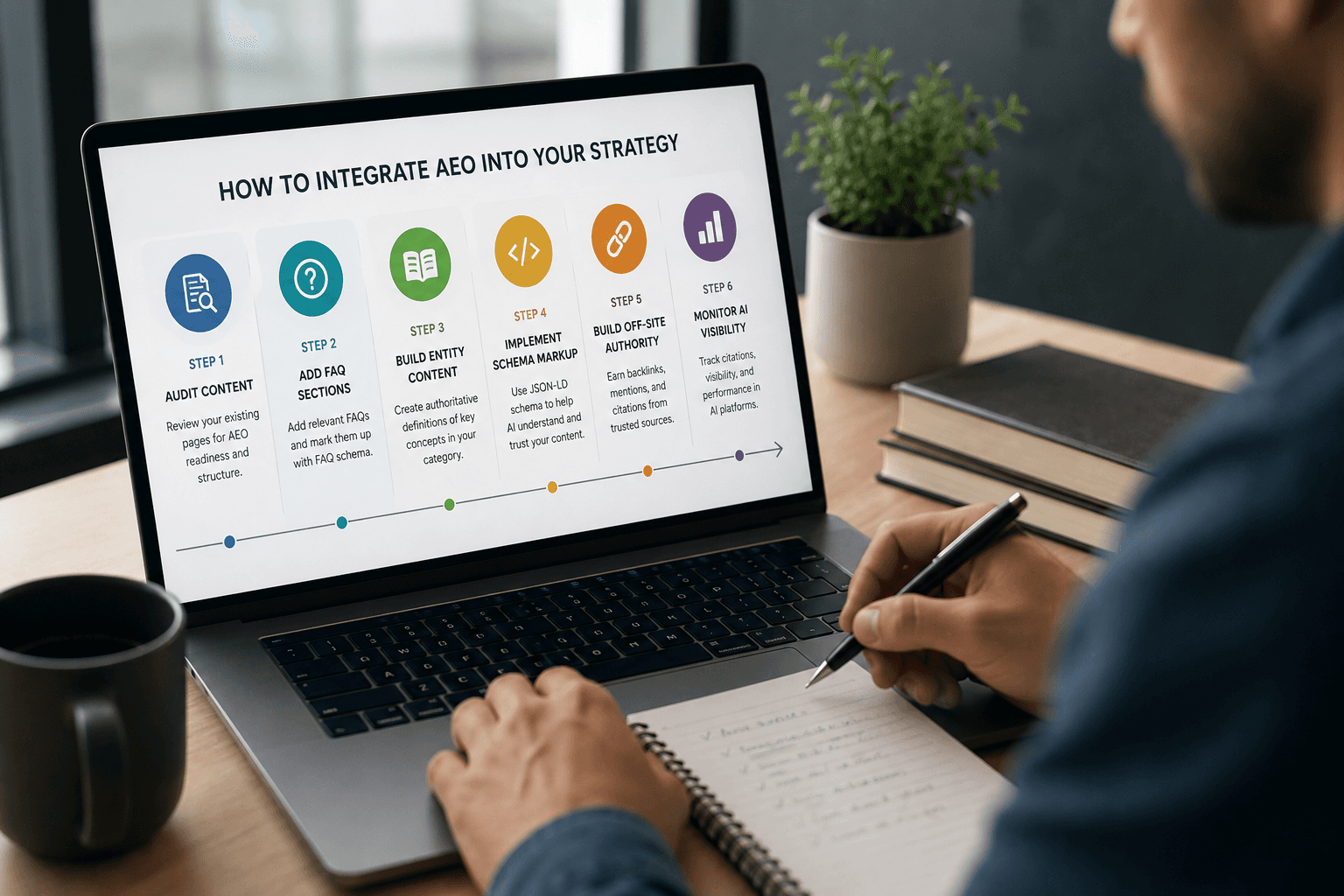
By now you understand the what and the why of AEO. Let's get practical with the how. Here is a step-by-step approach to integrating AEO into your existing marketing strategy without throwing away the SEO work you have already done.
Step one is to audit your existing content for AEO readiness. Go through your highest-traffic and most commercially important pages. Ask yourself: does this content clearly define key terms? Does it answer specific questions directly? Is it structured in a way that an AI system could easily extract a citable answer from it? Most existing SEO content fails these tests because it was optimized for reading experience and keyword density rather than AI-parseable structure.
Step two is to add FAQ sections to your key pages. FAQ sections are one of the highest-impact AEO improvements you can make. They give AI systems pre-packaged, citable question-and-answer pairs. For each of your key pages, identify the five to ten most common questions your target audience asks about that topic, and add clear, concise answers. Then mark these up with FAQ schema so AI systems can identify them with certainty.
Step three is to build your entity definition content. Create clear, authoritative definitions of the most important concepts in your category. If Aetrix is building authority in the AEO space, it makes sense to publish the clearest, most comprehensive definition of AEO available anywhere on the web. This positions Aetrix as the authoritative source on the term itself.
Step four is to implement schema markup across your site. JSON-LD schema markup, including Organization schema, Product schema, FAQ schema, HowTo schema, and Article schema, gives AI systems machine-readable signals about what your content is, who created it, and why it should be trusted.
Step five is to build your off-site authority. This means acquiring backlinks from high-authority sources, yes, but it also means pursuing brand mentions, being included in industry roundups and listicles, getting quoted as an expert in trade publications, and building your presence in the databases and directories that AI systems draw from.
Step six is to monitor your AI visibility. This is where tools like Aetrix become essential. You need to track how frequently your brand is being cited in AI answers, which AI systems are citing you, and which content is driving those citations. Without this data, you are flying blind.
SEO Tools vs AEO Tools: Understanding the Landscape
Let's take a moment to honestly compare the tool landscape, because this is where many marketers feel the gap between what they need and what is available most acutely.
Semrush is one of the most comprehensive SEO platforms available. It provides keyword research, competitor analysis, site audits, backlink data, position tracking, and content optimization suggestions. For traditional SEO, it is exceptional. It has tens of millions of keywords in its database, powerful SERP analysis features, and integrations with Google Analytics and Search Console. However, Semrush's visibility into AI answer environments is essentially zero. It cannot tell you whether you are being cited in ChatGPT responses, how your content performs in Perplexity searches, or whether your brand appears in Google AI Overviews.
Ahrefs is the premier tool for backlink analysis and has expanded significantly into content research and keyword exploration. Its Content Explorer, Keywords Explorer, and Site Audit features are industry-leading. Ahrefs is also highly valued for its web crawler data and the freshness of index updates. Like Semrush, however, it is fundamentally an SEO tool. It provides no meaningful insight into AI search visibility.
Moz has been a cornerstone of the SEO community for over 15 years. Its Domain Authority metric is widely used as a proxy for website authority. Moz Pro offers keyword research, rank tracking, link-building tools, and site crawl capabilities. Moz has also built a strong educational brand through its Whiteboard Friday videos and SEO guides. Again, though, Moz has no AEO-specific functionality.
Aetrix occupies a fundamentally different space. It was built from the ground up for the AI search era. Rather than tracking keyword rankings in Google, Aetrix tracks AI citation frequency and brand visibility across AI answer engines. Rather than auditing your website for technical SEO issues, Aetrix audits your content for AEO readiness, identifying gaps in structured content, schema markup, entity definition, and question-answering coverage. Rather than building backlink reports, Aetrix helps you understand where your brand is appearing in AI-generated answers and what you need to do to increase that presence.
The comparison is not about which tool is better in absolute terms. It is about whether you are using the right tool for the job at hand. If you want to rank higher in Google, Semrush, Ahrefs, and Moz are excellent choices. If you want to appear in AI-generated answers, you need Aetrix.
Real-World Impact: What Happens When Companies Prioritize AEO
Theory is useful, but let's talk about what actually happens when companies begin treating AEO as a strategic priority alongside or even above traditional SEO.
The first thing that happens is better-qualified discovery. When users find you through AI-generated answers, they arrive with a higher level of intent and context than typical organic search visitors. They have already asked a specific question. The AI has already provided an answer that positions your brand as a credible solution. This pre-qualification leads to higher engagement rates, lower bounce rates, and in many cases, faster conversion timelines.
The second thing that happens is category authority. When your brand is consistently cited in AI answers related to your category, you become the category authority in the AI's "mind." This creates a self-reinforcing cycle: the more you are cited, the more confident AI systems become in your authority, which leads to more citations. Early-mover advantage in AEO is real and significant.
The third thing that happens is resilience against Google algorithm updates. If a significant portion of your visibility comes from AI answer citations rather than traditional search rankings, you are insulated from the volatility of Google algorithm changes. Companies that built their entire growth strategy on Google organic traffic have been devastated by core updates. AEO provides a genuine diversification of your visibility.
The fourth thing that happens is competitive differentiation. Right now, most of your competitors are still thinking primarily in traditional SEO terms. They are tracking keyword rankings and building backlinks. Very few have begun seriously investing in AEO. The companies that invest in AEO now, before it becomes table stakes, will build authority advantages that are difficult for later movers to overcome.
Aetrix (https://www.aetrixhq.com/) was built to help SaaS companies capture this early-mover advantage. Our platform provides the data, recommendations, and automation needed to execute AEO at scale, without requiring you to build a team of specialists or invest months in manual research.
The Future of Search: Where SEO and AEO Are Headed
Before we wrap up, let's look forward. Where is all of this heading? What does search look like in three to five years, and how should you be positioning your strategy now to be ready?
The trajectory is clear. AI answer engines are going to become more capable, more widely used, and more deeply integrated into how people find information and make decisions. Google is not going to abandon its core search product, but it will continue shifting toward AI-synthesized answers, particularly for high-intent, research-oriented queries. Standalone AI assistants like ChatGPT and Perplexity will continue growing their user bases and improving their search and synthesis capabilities.
For marketers, this means the importance of AEO will only increase. The brands that establish themselves as authoritative sources in AI answer environments now will have compounding advantages as AI search grows. The brands that ignore AEO and focus exclusively on traditional search rankings will find themselves progressively more invisible to a growing segment of their target audience.
It also means that the integration of SEO and AEO will deepen. As AI search and traditional search continue to converge, we will see the emergence of unified search optimization strategies that consider both forms of visibility holistically. The brands that figure out this integration first will have a significant competitive edge.
For tools like Semrush, Ahrefs, and Moz, the challenge is whether they can evolve fast enough to serve AEO's needs. All three have the data infrastructure and user bases to potentially expand into AI search optimization. Whether they will move fast enough remains to be seen.
For Aetrix (https://www.aetrixhq.com/), the opportunity is to establish the definitive platform for AI search optimization while the field is still young, building the data models, product features, and industry authority that will make it the go-to tool for the next era of search marketing.
The bottom line is simple: if you are only doing SEO in 2026, you are leaving a growing portion of your potential visibility on the table. AEO is not the future. It is the present. The brands that treat it that way now are the ones that will dominate their categories in the AI search era.
Conclusion: What Actually Matters in 2026
So, back to the original question: SEO vs AEO, what actually matters in 2026?
The honest answer is both, but with a rapidly shifting balance.
SEO still matters because Google is still the largest search engine in the world, and organic search is still a massive channel for discovery, especially for content-driven and long-tail queries. Your technical foundations, content quality, and backlink profile still drive meaningful traffic and lead generation. Do not abandon your SEO program.
But AEO matters more and more with every passing month, because the fastest-growing search behaviors now involve AI answer engines. Your most valuable, highest-intent potential customers are increasingly asking AI systems for recommendations, research assistance, and category education. If you are not showing up in those answers, you are invisible to them.
The companies that will win in 2026 and beyond are the ones that treat SEO and AEO as complementary, integrated strategies. They will maintain their SEO foundations while systematically investing in the structured content, schema markup, entity optimization, and authority building that drives AI answer visibility.
If you want to see how your SaaS company currently performs in AI answer environments and get a clear roadmap for improving your AEO, visit Aetrix today. We built the tools, data, and frameworks specifically for this moment in search history.
The search game has changed. It is time to play it differently.

The Technical Side of AEO: Schema, Entities, and Structured Data Explained
For many marketers, the technical side of AEO can feel intimidating. Schema markup, JSON-LD, entity graphs- these terms belong to a world that has historically been the domain of developers and technical SEO specialists. But in 2026, a working understanding of these technologies is essential for any marketing leader who wants to maintain and grow digital visibility.
Let's start with schema markup. Schema markup is a standardized vocabulary of tags that you can add to your website's HTML to provide search engines and AI systems with explicit, machine-readable information about your content. Rather than asking AI systems to infer what your page is about from its text content, schema markup tells them directly: "This is an FAQ page. These are the questions. These are the answers." Or: "This is a product page. This is the product name. This is the price. These are the features."
Schema markup is implemented using a format called JSON-LD (JavaScript Object Notation for Linked Data), which is Google's recommended format and the one most widely supported by AI systems. You embed a script tag in the head of your HTML page containing a structured data object that describes your content.
Here is a simple example of an FAQ schema for an AEO-optimized page:
The schema tells AI systems explicitly that the page contains FAQ content, what the questions are, and what the corresponding answers are. When ChatGPT or Google's AI Overview system processes this page, the structured data makes it trivially easy to extract and cite the Q&A pairs.
Entity optimization is another technical cornerstone of AEO. In the context of AI systems, an entity is a real-world thing, whether a person, company, product, concept, or location, that can be unambiguously identified and distinguished from other things. Google's Knowledge Graph is essentially a massive database of entities and the relationships between them.
Your company is an entity. Your product is an entity. The key concepts in your category are entities. For AI systems to confidently associate your brand with authority in a specific domain, your entities need to be clearly defined and consistently represented across the web.
Entity optimization involves several practical activities. First, you need an authoritative entity definition on your own website, typically on your About page or homepage. This definition should clearly state your company name, what you do, who you serve, where you are located, and what makes you uniquely authoritative. Second, your entity definition should be consistent across external platforms: LinkedIn, Crunchbase, G2, Capterra, Wikipedia (if appropriate), and any relevant industry directories. Third, your entity should have clear relationships to other entities: your industry category, your competitors, your complementary tools, and the key concepts in your space.
The Google Knowledge Graph is the most important entity database for traditional search. Being represented in the Knowledge Graph with a well-developed entity record increases your visibility in Google's AI Overviews and AI answer systems. You can check and influence your Knowledge Graph representation through your Google Business Profile, structured data implementation, and Wikipedia presence.
Wikidata, the machine-readable data repository underlying Wikipedia, is another entity database that feeds directly into AI training data. If your company is significant enough to have a Wikidata entry, creating and maintaining one can meaningfully improve your entity representation in AI systems.
The relationship between schema markup, entity optimization, and AEO is foundational. These technical practices create the machine-readable signals that AI systems need to confidently cite your content. Without them, your content may be high-quality but invisible to AI systems in the structured, citable way that AEO requires.
Aetrix includes a technical AEO audit that evaluates your schema implementation, entity clarity, and structured data coverage, providing specific recommendations for closing any technical gaps that are limiting your AI citation potential.
Content Strategy for AEO: How to Write Content That AI Systems Love
Writing for AEO is a distinct skill from writing for traditional SEO, though there is significant overlap. Understanding the specific content patterns that AI systems prefer is essential for producing content that gets cited.
The most important principle in AEO content writing is what we call the "citation-first" approach. Every piece of content you write should be designed with the question: "What citable statement can AI systems extract from this?" This does not mean your content should be dry or robotic. It means that within every article, guide, or page, you should deliberately include clear, precise, citable statements that directly answer specific questions.
A citable statement has several characteristics. It is specific rather than vague. "AEO can improve AI citation frequency by 40% within six months" is citable. "AEO can help improve your visibility" is not. It is a complete thought that stands on its own, meaning it can be extracted from its context and still convey meaningful information. It is accurate and verifiable. AI systems, particularly Perplexity and search-enabled ChatGPT, are increasingly capable of fact-checking claims and will deprioritize content with dubious statistics.
The heading structure of your content is critical for AEO. AI systems use heading hierarchies to understand the topical structure of your content and to identify which sections answer which questions. Best practice is to use question-based headings for the key sections of your content. Instead of "Benefits of AEO," write "What are the key benefits of Answer Engine Optimization for SaaS companies?" This directly signals to AI systems that the following section answers that specific question.
The opening paragraph of each section should lead with the direct answer. This inverted pyramid structure, where the most important information comes first, and supporting details follow, is the format most compatible with AI citation. AI systems frequently extract only the first one to two sentences of a section to use as a citation. If your answer is buried in paragraph five after an extensive preamble, it may never get cited, even if it is the best answer available.
Long-form content still has value in AEO, but its value is different from its value in traditional SEO. In traditional SEO, long-form content signals comprehensiveness and can rank well for multiple related keywords. In AEO, long-form content is valuable because it provides multiple citation opportunities, covers multiple questions that AI systems might want to answer, and demonstrates topical authority that builds entity associations. But the structure must ensure that each section is independently citable, not just comprehensively written.
FAQ sections deserve special emphasis. Well-crafted FAQ sections with specific, direct answers are among the highest-value content investments for AEO. They provide explicitly structured Q&A pairs that are ideally formatted for AI citation. They cover the conversational query formats that users submit to AI systems. And they are easy to implement with FAQ schema markup. For any key page on your website, adding five to ten well-crafted FAQ entries with schema markup is one of the quickest wins available in AEO.
Aetrix provides content writing guidance specifically optimized for AI citability, helping SaaS content teams produce content that performs in both traditional search and AI answer environments.
Measuring AEO Success: The Metrics That Matter in the AI Search Era
One of the biggest challenges in AEO adoption for established marketing teams is the measurement question. If you have been measuring content marketing success through keyword rankings, organic traffic, and conversion rates, how do you adapt your measurement framework to account for AEO performance?
The answer is to build a layered measurement framework that combines existing SEO metrics with AEO-specific metrics. You do not abandon your existing measurement infrastructure; you add a new layer that captures AI search performance.
The foundational AEO metric is AI citation frequency. This measures how often your brand, content, or specific claims are cited in AI-generated responses to queries in your target category. To measure this, you need to systematically query AI platforms, including ChatGPT, Perplexity, Google AI Overviews, and others, with the most important questions your target buyers ask, and track whether your brand appears in the responses.
Doing this manually is time-consuming and limited in scale. Aetrix automates this process, continuously monitoring your brand's citation frequency across AI platforms and tracking changes over time in response to your content and optimization activities.
The second important metric is AI citation share, which measures your brand's citation frequency as a percentage of all brand citations in your category. If your category's key questions are answered by AI systems with citations to five different brands, and your brand appears in 40% of those answers, that is your AI citation share. Tracking this relative metric is important because absolute citation frequency can grow simply because AI search is growing, while your relative competitive position may be flat or declining.
The third metric is query coverage, which measures what percentage of the key questions in your category you are being cited for at all. If there are 100 important buyer questions in your category and you are being cited in responses to 30 of them, you have 30% query coverage. Improving query coverage requires identifying the specific questions where you are absent and creating or optimizing content to address them.
The fourth metric is brand mention sentiment in AI answers. Not all brand mentions are equally positive. Some AI systems cite your brand positively as a recommended solution. Others might mention you in a neutral comparison context. Tracking the sentiment and context of your brand mentions in AI answers provides insight into how AI systems are characterizing your product.
The fifth metric is the downstream impact on traditional analytics. While AI citations do not always drive direct traffic, they influence brand awareness and recognition that shows up in indirect ways: increased brand search volume, higher direct traffic, improved landing page conversion rates from organic visitors who have encountered your brand in AI answers before arriving at your site. Monitoring these indicators provides evidence of the brand equity value of AI citation.
Traditional SEO tools like Semrush and Ahrefs continue to provide the keyword ranking and backlink data that remains relevant for traditional search performance. Moz provides the domain authority metrics that correlate with both SEO performance and AI citation authority. Aetrix (https://www.aetrixhq.com/) provides the AI-specific metrics that complete the picture.
AEO for Different SaaS Verticals: Category-Specific Strategies
While the principles of AEO apply across all SaaS categories, the specific execution differs meaningfully depending on your vertical, your buyer persona, and the nature of the questions your target buyers are asking AI systems.
For marketing technology SaaS, including tools for email marketing, marketing automation, content management, and SEO, the AEO landscape is highly competitive. Most martech buyers are sophisticated digital marketers who are early adopters of AI tools. They are already using ChatGPT and Perplexity extensively for their own research. For martech companies, AEO is not just important; it is urgent. The buyers you are trying to reach are exactly the users who are most actively using AI search tools for category research.
The key AEO priorities for martech SaaS include comprehensive comparison content, because sophisticated buyers want to understand how you compare to alternatives. They also include original benchmark and research data, because AI systems will cite your data if it is the best available. And they include clear, jargon-free definitions of your category concepts, because AI systems need to understand what you do before they can recommend you.
For developer tools and infrastructure SaaS, the AEO landscape is centered on documentation quality, technical accuracy, and community presence. Developers use AI coding assistants and technical research tools heavily. ChatGPT is used by millions of developers daily for coding assistance and technical research. The questions developers ask AI systems are highly specific: "How do I integrate X with Y?" "What is the best tool for Z use case?" "What are the performance tradeoffs between A and B?"
For developer tool SaaS, AEO priorities include having comprehensive, accurate, and well-structured technical documentation that AI systems can cite. They also include a strong presence on developer community platforms like Stack Overflow, GitHub, and developer blogs, which feed into AI training data. And they include clear, specific answers to the "how do I" and "when should I use" questions that developers ask AI systems constantly.
For HR technology, finance technology, and compliance SaaS, AEO is shaped by the specific characteristics of those buyers: risk-averse, heavily regulated, and deeply concerned with accuracy and authority. AI systems answering questions in these verticals will heavily weigh the authority and credibility of their sources. A citation from an accounting industry publication or HR compliance resource carries more weight than a generic blog mention.
For these verticals, AEO priorities include deep engagement with industry publications and authoritative bodies, original compliance and regulatory guidance content, and strong E-E-A-T signals, including certified expert authorship and organizational credentials.
Regardless of vertical, the common thread is understanding exactly how your specific buyers are using AI systems in their research process and systematically building the content and authority signals that answer their specific questions. Aetrix helps SaaS companies in any vertical map their buyers' AI query patterns and build a targeted AEO strategy around them.