Why Your Brand Is Not Showing Up in ChatGPT Answers (And How to Fix It)
You search for your own brand in ChatGPT. It either does not mention you at all, or it gets something wrong. A competitor shows up where you should be. This is one of the more unsettling experiences for marketing and growth teams right now.
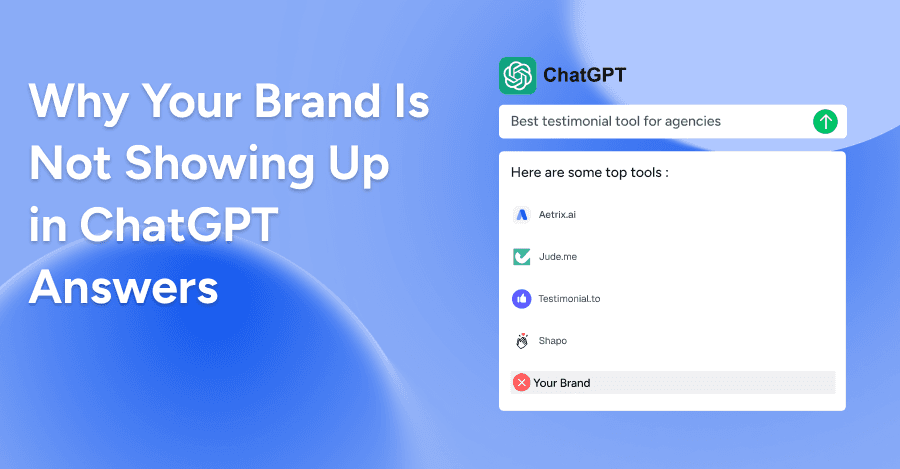
The problem is real and it is fixable. But fixing it requires understanding why it happens in the first place.
Why Your Brand Is Not Showing Up in ChatGPT Answers (And How to Fix It)
You search for your own brand in ChatGPT. It either does not mention you at all, or it gets something wrong. A competitor shows up where you should be. This is one of the more unsettling experiences for marketing and growth teams right now.
The problem is real and it is fixable. But fixing it requires understanding why it happens in the first place.
How ChatGPT decides what to recommend
ChatGPT and similar AI tools generate responses based on patterns learned during training, sometimes supplemented by real-time retrieval from the web. When a user asks what tools are available for a given task, the model draws on whatever it encountered about that category during training.
If your brand was not present in that data in a meaningful way — or if the mentions that existed were sparse, ambiguous, or negative — the model will not surface you. It is not making an editorial judgement about your product. It simply does not have enough reliable signal about you to include you confidently.
Why Brands Go Missing — The Five Most Common Reasons
Reason | What it means | How to fix it |
Presence too thin | Few pages, no blog, minimal external coverage | Publish 8-12 targeted posts, get listed on G2 |
Brand is too new | Launched after model training cut-off | Focus on retrieval engines: Perplexity, AI Overviews |
No third-party mentions | Only your own site talks about you | PR, reviews, community mentions |
Content doesn't answer questions | Pages written for keywords, not questions | Restructure content with direct Q&A format |
Positioning is unclear | Vague value prop, inconsistent descriptions | Plain-language description on every profile |
A closer look at each reason
1. Your online presence is too thin
AI models weight the breadth and depth of content about a brand. If your website has a handful of pages and no blog, you are underrepresented in the data the model trained on. There is not enough signal to treat you as a well-established option.
Real example
A B2B analytics tool launched in 2023.
Website had: homepage, pricing page, two product pages. No blog, no reviews.
ChatGPT prompt: 'Best analytics tools for SaaS startups'
Result: six competitors named. Their brand not mentioned once.
After: 8 targeted blog posts + G2 listing + Product Hunt launch.
Result: brand started appearing in the same prompt within 6 weeks.
2. Your brand is too new
Most large language models have training data cut-offs. A brand that launched after that cut-off will have lower visibility in base model outputs. This is a structural limitation, but retrieval-augmented engines like Perplexity and Google AI Overviews pull content indexed in real time — so recent, well-structured content can appear in these engines within days.
3. Third-party sources do not mention you
AI tools weight independent, authoritative sources more heavily than a brand's own website. If review platforms, industry publications, and community forums do not mention you, the model has no external validation. Your own content alone is not sufficient.
Real example
A cybersecurity startup had detailed documentation and a 20-post blog.
Still not appearing in ChatGPT for their category.
Investigation: zero G2 reviews, no industry publication coverage,
no Reddit or forum mentions where security teams discuss tools.
All content existed on their own domain. Nothing existed anywhere else.
Fix: 3 months of external PR + 12 G2 reviews + 2 security newsletter mentions.
Result: brand started appearing in primary category prompts within 8 weeks.
4. Your content does not answer the questions people are asking
Retrieval-augmented systems look for content that directly answers the query. Pages written for keyword density rather than clear question-and-answer structure are less likely to be retrieved and cited.
Practical exercise — find your content gaps in 2 hours
Step 1: Write down the 5 questions your sales team is asked most on discovery calls.
Step 2: Run each as a prompt in ChatGPT and Perplexity. Note which competitors appear.
Step 3: For each prompt where you do not appear, check whether you have a page that directly answers that question.
Step 4: Every missing answer = one content gap. Write a page for each. Put the answer in the first paragraph, not buried 300 words in.
This exercise takes 2 hours and identifies exactly where to write next.
5. Your category positioning is unclear
If it is not obvious from your web presence what problem you solve and for whom, AI systems struggle to slot you into a recommendation. The model cannot confidently recommend something it cannot clearly categorise.
How to fix it: the priority order
Get listed on G2, Capterra, or the most relevant review platform for your category. This is the fastest external signal to add.
Write 8 to 12 blog posts directly answering the questions your buyers ask. Each post targets one specific question. Answer it in the first paragraph.
Update your homepage and product pages with a plain-language description of exactly what you do, who it is for, and what problem it solves.
Pursue two or three pieces of press coverage or expert roundup inclusions. Quality matters more than volume.
Run the same 10 to 15 prompts in ChatGPT and Perplexity every two weeks. Track which ones start showing your brand as your content and presence grows.
What to avoid
Do not stuff exact phrases into content in ways that read unnaturally. Do not focus exclusively on ChatGPT — Perplexity, Gemini, and Google AI Overviews each have different retrieval logic, and a brand visible in one might be absent from another.
Summary
If your brand is not appearing in ChatGPT answers, the issue is usually not random. AI tools surface brands based on the strength of their online presence, third-party mentions, clear content structure, and category relevance.
The most common reasons brands go missing are thin web presence, lack of external validation, unclear positioning, or content that does not directly answer the questions users ask AI tools.
The good news is that these issues are fixable. Publishing answer-focused content, building third-party mentions, clarifying your positioning, and monitoring AI visibility over time can significantly improve how often your brand appears in ChatGPT, Perplexity, Gemini, and other AI-powered search experiences.
Frequently Asked Questions
Why is my brand not showing up in ChatGPT answers?
The most common reasons are: your online presence is too thin, your brand launched after the model training cut-off, there are few third-party sources mentioning you, your content does not directly answer the questions users ask, or your category positioning is unclear. Most of these can be fixed with targeted content and external presence building within 6 to 12 weeks.
How long does it take for a brand to start appearing in ChatGPT?
For retrieval-augmented engines like Perplexity and Google AI Overviews, well-structured content can start appearing in responses within days to weeks. For base model outputs in ChatGPT, changes depend on model retraining cycles and typically take longer. External mentions and structured content generally produce visible results within 6 to 12 weeks.
Does my own website content help me appear in ChatGPT answers?
Yes, but not alone. AI tools use your website as one signal among many. Third-party mentions — reviews, press coverage, community discussions — carry significant weight. Brands that rely only on their own website content consistently score lower than brands with strong external presence.
What type of content makes a brand appear in AI answers?
Content that directly answers specific questions, uses plain language, has clear structure with headings, and is published on a credible domain. FAQ sections, definition pages, comparison guides, and how-to articles perform well. Long introductory paragraphs and keyword-heavy writing perform poorly.
How do I check which AI engines mention my brand?
Run prompts in ChatGPT, Perplexity, Gemini, and Claude and record the results manually. For systematic tracking across multiple prompts and engines over time, a dedicated AEO monitoring tool automates this and tracks changes.