Is SEO Dead? Here's What's Actually Happening
The 'SEO is dead' debate is back — but this time there's real data behind it. Discover what's actually changing in search, what still works, and what you must do differently in 2026.

Is SEO Dead? Here's What's Actually Happening
Every few years, someone declares that SEO is dead. In 2011, it was the Panda update that was going to kill content farms and supposedly SEO with them. In 2016, voice search was going to make keywords obsolete. In 2019, featured snippets were going to eliminate organic clicks. And every time, the SEO community came back with data proving that SEO was very much alive and delivering results.
But 2026 feels different. The people asking "is SEO dead?" this time are not bloggers generating traffic with a provocative headline. They are CMOs watching their organic traffic decline despite technically sound SEO. They are SaaS founders who have invested heavily in content for years and are suddenly seeing that investment deliver diminishing returns. They are digital agencies whose clients are questioning whether their monthly SEO retainers are still justified.
This time, the question deserves a serious, data-driven answer.
So let us be direct: SEO is not dead. But parts of it are dying, and new disciplines, primarily Answer Engine Optimization (AEO), are rising to fill the gaps. If you want to understand what is actually happening in search right now, why it is happening, and what you should do about it, this is the guide you have been looking for.
We are going to cover the hard data on organic traffic trends, the specific SEO tactics that no longer work, what still delivers results, and how AEO is reshaping the competitive landscape for SaaS companies and digital marketers. By the end, you will have a clear, honest picture of the search landscape in 2026, and a framework for adapting your strategy accordingly.
The Data Behind the Decline: What Is Actually Happening to Organic Traffic
Let's start with the data, because the conversation about SEO's health should not be driven by anecdote or anxiety. It should be driven by what the numbers actually show.
The most significant data point is the zero-click search rate. Research from SparkToro and Datos published in 2024 found that approximately 58.5% of Google searches in the United States ended without a click on any result. That is a majority of searches generating no website traffic at all. The comparable figure in Europe was even higher at around 59.7%.
What is driving this? Multiple factors converge. Google's featured snippets, which extract and display a direct answer at the top of search results, eliminate the need to click through for millions of informational queries. Google's Knowledge Graph panels provide structured information about people, places, companies, and concepts directly on the results page. And most significantly in 2026, Google's AI Overviews are appearing for a growing percentage of queries, synthesizing multi-source answers that users can read without ever leaving Google.
A 2024 study by BrightEdge found that AI Overviews were appearing in approximately 15 to 20% of all Google search results, with that percentage significantly higher for research-oriented and long-tail queries, exactly the type of queries that typically drove the most valuable content marketing traffic.
The implications for click-through rates are stark. Historically, the number-one position in Google organic results received a click-through rate of roughly 25 to 30%. That number has been declining steadily. By 2024, the average click-through rate for position one was closer to 13 to 18% for many query types, and in queries where an AI Overview appeared, the impact on organic clicks was even more significant.
Semrush (https://www.semrush.com) data has shown declining organic traffic for a significant percentage of websites even as their keyword rankings have held steady or improved. This is the critical disconnect that is confusing many marketers: your rankings look fine, but your traffic is declining. The reason is that rankings matter less when fewer users are clicking through to any organic result.
Ahrefs research has similarly documented the growing prevalence of AI-generated content in Google search results and its impact on organic click distributions. Their data suggests that high-traffic informational keywords are particularly affected by zero-click trends.
This is the environment in which the "SEO is dead" narrative has gained its most serious traction. And it is important to acknowledge that these are real trends with real implications, not just breathless hyperbole.
What Parts of SEO Are Actually Dying
Rather than treating SEO as a monolithic practice that either lives or dies, it is more useful to examine which specific components are becoming less effective and why.
The first component under serious pressure is informational keyword optimization. For years, one of the most reliable SEO strategies was to identify informational keywords, which are queries like "how to do X" or "what is Y," research the search intent behind them, and write comprehensive articles that ranked well and drove significant traffic. These articles would educate readers, build brand awareness, and ideally lead to product consideration.
This strategy is being hollowed out by AI Overviews and featured snippets. When someone searches "how to write a cold email," they no longer need to visit HubSpot or Mailchimp's blog to get an answer. They get a synthesized, AI-generated answer at the top of the page. The traffic that used to flow to content marketing blogs from these informational queries is fragmenting and, in many cases, disappearing.
The second dying component is thin or derivative content. For years, the SEO playbook included a tactic sometimes called "10x content," which involved taking a topic that was ranking and simply writing a longer, more comprehensive version. This worked when Google's primary goal was to find the most thorough treatment of a topic. In 2026, with AI capable of synthesizing information from dozens of sources simultaneously, there is diminishing value in being the most comprehensive single document on a topic. AI can just combine the best insights from multiple sources.
The third component losing effectiveness is keyword stuffing and artificial density optimization. Some SEO practitioners still focus heavily on keyword density, synonyms, and LSI keywords as optimization tactics. These tactics worked reasonably well in earlier Google algorithm generations. Google's current models, which are themselves large language models, understand context and semantic meaning far more deeply than keyword matching. Keyword density optimization is not just losing effectiveness; it is increasingly actively penalized.
The fourth component that is struggling is link acquisition through guest posts on low-quality sites. The guest posting tactic has been a staple of link building for a decade. You write an article, place it on another website, and get a backlink. Google has been cracking down on this practice for years, and its ability to identify low-quality, link-focused guest post networks has improved dramatically. Pure link volume, without genuine topical relevance and source authority, is delivering progressively less ranking benefit.
What SEO Still Does Well: The Parts That Are Thriving
With the caveats above clearly stated, it is essential to understand what SEO still does exceptionally well. Declaring it entirely dead would be just as misleading as pretending nothing has changed.
Commercial intent keywords remain highly valuable SEO real estate. When someone searches "best CRM for SaaS startups" or "Salesforce alternatives for small business," they are in a buying mode. Google still shows organic results prominently for these queries, and the clicks that come from commercial intent searches convert at significantly higher rates than informational traffic. High-quality content that ranks for commercial intent keywords continues to be one of the most valuable digital assets a SaaS company can own.
Technical SEO remains foundational for every digital strategy. A website that is slow to load, has broken internal links, blocks crawlers from key content, or has duplicate content issues will struggle in both traditional search and AI search environments. The technical fundamentals of SEO, site speed, crawlability, URL structure, mobile optimization, and schema markup, are not going away. They are actually becoming more important as they are now prerequisites for both SEO and AEO success.
Local and hyperlocal SEO is remarkably robust against AI disruption. When someone searches for a local service, a nearby restaurant, or a business in their area, Google's local results, including the Map Pack, are still highly click-driven and less susceptible to AI Overview disruption. If your SaaS has any local or geographic component to its marketing, local SEO remains a high-value investment.
Brand-driven search is increasingly important and very defensible. Searches that include your brand name, your product name, or specific navigational intent are still largely click-driven. Building a strong enough brand that people search directly for you is one of the most durable digital marketing investments you can make. Moz's domain authority research consistently shows that strong brands build strong organic presences that are more resilient to algorithm changes and AI disruption.
Backlink-driven authority, when the backlinks are genuinely from high-quality, topically relevant sources, continues to move rankings for competitive keywords. Ahrefs research consistently confirms that backlink authority remains one of the strongest predictors of organic rankings for competitive queries. The issue is not that backlinks have stopped working; it is that low-quality backlink acquisition has stopped working.
Enter AEO: The Discipline Rising to Fill the Gap
As parts of traditional SEO decline in effectiveness, Answer Engine Optimization is emerging to fill the visibility gap. AEO is not SEO's replacement; it is its evolution.
AEO is the practice of optimizing your content and brand to appear in AI-generated answers. This includes appearances in ChatGPT responses, Perplexity answers, Google AI Overviews, Microsoft Copilot responses, and any other large language model-based information system that users are turning to for research and discovery.
The core insight of AEO is that in a world where AI systems synthesize answers rather than just returning links, the game is no longer just about ranking in a list. It is about being the source that the AI trusts to cite when answering questions in your category.
Think about this from a buyer's perspective. A SaaS buyer who is evaluating project management tools in 2026 might start by asking ChatGPT: "What are the best project management tools for a remote SaaS team of 20 people?" ChatGPT will synthesize an answer that probably mentions three to five specific tools, explains the key differentiators, and provides some guidance on what to consider. The buyer will likely investigate the tools that were mentioned. If your product is not mentioned, you never entered the consideration set, regardless of how well you rank in Google.
This is why AEO is not optional for SaaS companies in 2026. It is the mechanism by which you ensure you are present in the AI-mediated discovery conversations that increasingly precede purchase decisions.
Aetrix was purpose-built for this shift. Rather than helping you track keyword rankings, Aetrix tracks AI citation frequency and helps you understand where your brand and content are appearing in AI answer ecosystems. Rather than auditing your technical SEO, Aetrix audits your content for AEO readiness and provides specific recommendations for improving your AI search visibility.
The Semrush, Ahrefs, and Moz Problem in 2026
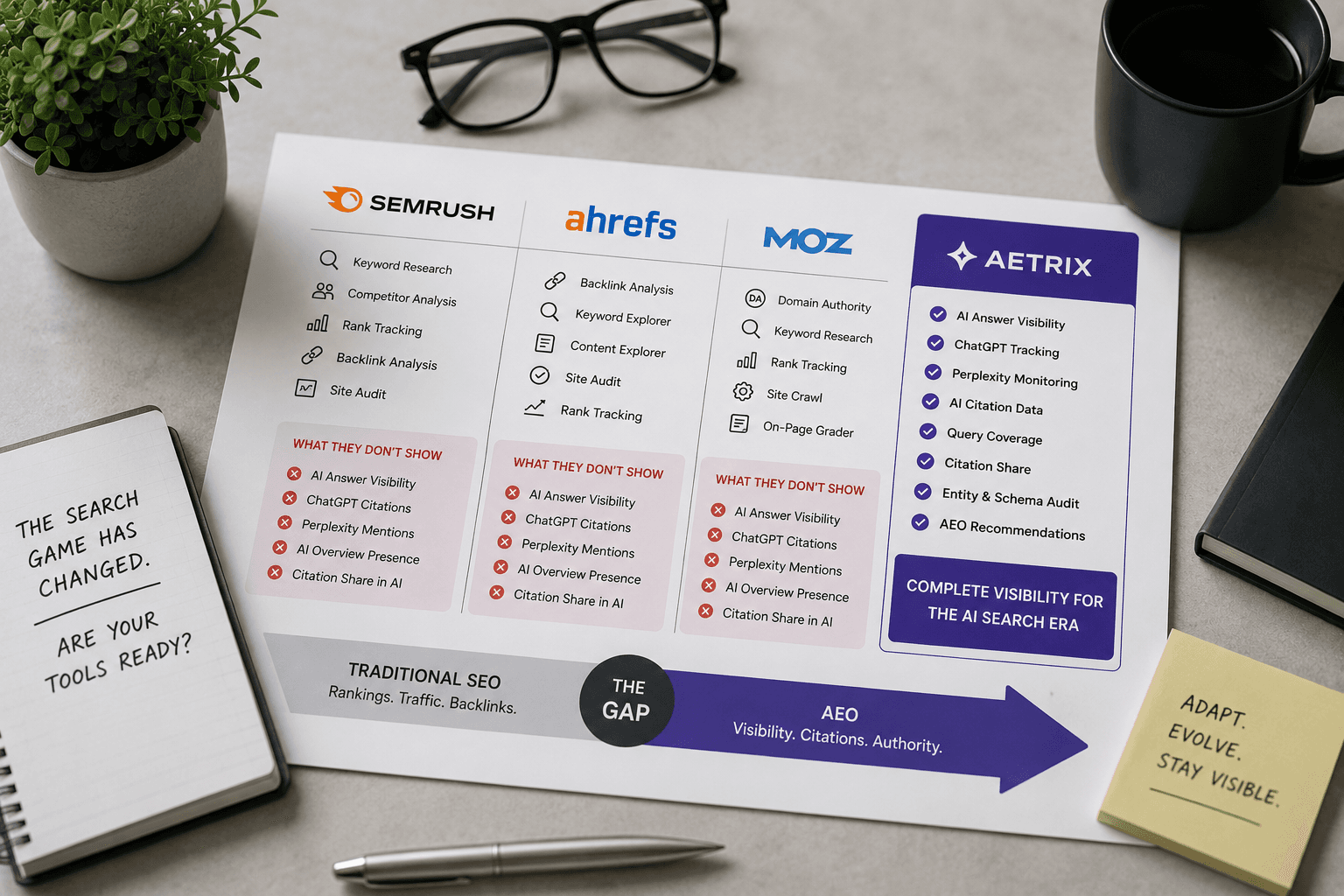
One of the clearest indicators that SEO as traditionally practiced is under pressure is the challenge facing the major SEO tool vendors.
Semrush is a publicly traded company with a strong, growing revenue base. Its product covers keyword research, competitor intelligence, content optimization, backlink analysis, and social media monitoring, among other things. It has been aggressively expanding its product surface area and has made some moves toward AI-related features. But fundamentally, its core value proposition remains helping you rank better in traditional search. Its keyword database, competitive intelligence, and rank tracking capabilities have no visibility into how content performs in ChatGPT, Perplexity, or Google AI Overviews.
Ahrefs is similarly positioned. It is an exceptional tool for backlink analysis, content gap research, and keyword exploration. Its web crawler, one of the most active on the internet, provides fresh, accurate data about the link profiles and keyword rankings of millions of websites. But like Semrush, Ahrefs has no capability to tell you whether you are appearing in AI-generated answers. Its product roadmap has not publicly indicated a near-term shift toward AEO-specific functionality.
Moz has historically positioned itself as the educational hub of the SEO industry. Its Domain Authority metric is widely used and trusted. Its Whiteboard Friday content series has educated generations of SEO practitioners. But Moz's core product has not evolved dramatically in recent years, and it faces the same fundamental challenge as Semrush and Ahrefs: the toolset is built for a search paradigm that is evolving rapidly away from its foundations.
None of this means these tools are useless. They remain valuable for the SEO work that still delivers results. But the gap between what they measure and what increasingly matters for digital visibility is growing. SaaS companies that rely exclusively on Semrush, Ahrefs, and Moz data to guide their content strategy are working with an incomplete picture.
Aetrix fills the blind spot. It provides the AI visibility data that traditional SEO tools cannot, giving you a complete picture of your digital presence across both traditional search and AI answer environments.
The Signs Your SEO Strategy Needs an AEO Upgrade
How do you know if the SEO trends we have been discussing are affecting your specific business? Here are the most common warning signs.
The first warning sign is declining organic traffic despite stable or improving keyword rankings. If your Semrush or Ahrefs dashboard shows that your rankings are holding or improving, but your Google Search Console data shows declining clicks and impressions, you are almost certainly being affected by zero-click trends and AI Overviews. Your content is contributing to AI-generated answers, but users are not clicking through to your site.
The second warning sign is lower engagement rates on informational content. If your blog posts and educational guides are showing declining time on page, higher bounce rates, or fewer internal navigation clicks, it may be because users are arriving with a question that has already been partially answered by an AI Overview, and your content is not providing enough additional value to hold their attention.
The third warning sign is declining brand search volume. If fewer people are searching for your brand name directly, it may indicate that fewer people are encountering your brand in discovery contexts. This can be a sign that your visibility in AI answer environments is insufficient, meaning users are discovering competitor brands in AI responses and never encountering yours.
The fourth warning sign is competitive displacement in your category. If you notice that competitors are being mentioned more frequently in industry discussions, analyst reports, and social media conversations, they may be winning the AEO game even if their SEO metrics look similar to yours. Brand mention share in AI answers can precede shifts in brand recognition and market share.
The fifth warning sign is stagnating trial or demo sign-up rates from organic channels despite maintained traffic. High-quality AEO-driven traffic tends to convert better than generic SEO-driven informational traffic. If your conversion rates from organic are declining, the quality composition of your organic traffic may be shifting in ways that traditional SEO metrics do not capture.
If you are experiencing any of these warning signs, it is time to seriously invest in understanding your AEO position. Aetrix provides the diagnostic and strategic tools to do exactly that.
A Practical Action Plan: From Pure SEO to Integrated Search Strategy
Let us close this section with the most practical possible guidance: a step-by-step action plan for transitioning from a pure SEO strategy to an integrated SEO plus AEO approach.
The first action is to conduct an AI visibility audit. Query ChatGPT, Perplexity, and Google AI Overviews with the twenty most important questions your target buyers ask about your category. Document which brands and sources are being cited. Assess where your brand appears and where it does not. This is your AEO baseline. Aetrix automates this process, saving you hours of manual research.
The second action is to identify and fix your top content pages for AEO readiness. Take your twenty highest-traffic or commercially most important pages and run them through an AEO checklist. Does each page clearly define key terms? Does each page answer specific questions directly? Does each page have FAQ schema markup? Does each page have clear author attribution and expertise signals? Address the gaps systematically.
The third action is to create entity definition content. For your brand, your product, and the key concepts in your category, create dedicated definition pages. Write the clearest, most comprehensive definition of AEO available on the internet and host it on your domain. Make your brand synonymous with the authoritative definition of the concepts most central to your category.
The fourth action is to pursue AI citation-building activities alongside traditional link building. This means getting your brand and content cited in industry publications, analyst reports, and authoritative directories that are likely to be in AI training data. Guest contributions to highly authoritative publications in your space are valuable for both traditional SEO backlinks and AI citation authority.
The fifth action is to set up monitoring and measurement for AI visibility. Use Aetrix to track how your brand citation frequency in AI answers changes over time in response to your AEO activities. Connect this data to your overall marketing performance metrics so you can demonstrate ROI.
SEO is not dead. But the search game has changed fundamentally. The winners in 2026 are not the ones who are doing SEO the best. They are the ones who are combining excellent SEO with a serious, systematic investment in AEO. That is the integrated strategy that positions your SaaS company for sustainable visibility in the AI search era.
Conclusion: The Real Answer to 'Is SEO Dead?'
Is SEO dead? No. But it is different, and the difference matters enormously for how you allocate your time, budget, and content strategy.
The parts of SEO that are dying are the parts that relied on AI-disrupted search behaviors: pure informational keyword traffic, thin derivative content, and low-quality link schemes. These have either been eliminated by AI answer engines or are facing increasing pressure from algorithm improvements and zero-click trends.
The parts of SEO that are thriving are the parts that serve genuine user intent with genuine quality: commercial intent keywords, technical foundations, brand-driven search, and authority built on real expertise and real quality backlinks from genuinely authoritative sources.
And above all of this, AEO is rising as the new frontier of search visibility. The brands that understand this shift early, invest in structuring their content for AI citation, build their entity authority across AI training data, and track their AI visibility with tools like Aetrix (https://www.aetrixhq.com/) are positioning themselves for the next decade of digital growth.
The question is not whether to do SEO or AEO. It is how to do both intelligently, efficiently, and in a way that compounds your authority across both traditional and AI search environments.
That is what actually matters in 2026. And the brands that embrace it will leave behind those that are still arguing about whether SEO is dead.
The Google Algorithm Evolution: From Keywords to Intent to AI
To understand why SEO as traditionally practiced is under pressure, it helps to trace the evolution of Google's algorithm over the past decade and understand what it is becoming.
Google's original algorithm was essentially a keyword-matching system weighted by backlinks. A page that contained your keyword many times and had many links pointing to it would rank well. This is why early SEO focused so heavily on keyword density and link building. The algorithm was simple enough that you could optimize for it mechanically.
The Penguin and Panda updates of 2011 and 2012 were Google's first major moves to combat manipulation. Panda penalized low-quality content by evaluating pages for thin, duplicate, or low-value content. Penguin penalized manipulative link schemes by identifying unnatural link patterns. These updates made the algorithm harder to game, but it was still fundamentally a link-weighted keyword system.
The Hummingbird update in 2013 was more significant. It introduced semantic search capabilities, meaning Google began to understand the meaning and intent behind queries rather than just matching keywords. A search for "best coffee shop near me" could now return results even if no page contained those exact words, because Google understood what the searcher meant.
The BERT update in 2019 was another major step forward. BERT (Bidirectional Encoder Representations from Transformers) was one of the first large language model technologies applied to Google search. It dramatically improved Google's ability to understand the nuance, context, and natural language meaning of search queries. This made keyword stuffing and artificial keyword density even less effective, because Google was now understanding meaning rather than just matching words.
The MUM (Multitask Unified Model) update in 2021 was another LLM advance, enabling Google to understand information across different formats and languages simultaneously. And the integration of Gemini technology into Google's core search systems in 2023 and 2024 marked the most dramatic shift yet: Google's search now fundamentally uses AI to understand queries and evaluate content.
What this evolution means for SEO in 2026 is that Google's algorithm is now, at its core, a large language model system. It evaluates content much more like an intelligent reader would than like a simple keyword-matching database. This makes many traditional SEO tactics less effective, particularly those that were designed to manipulate signals that the old, simpler algorithm responded to.
But it also creates new opportunities. A Google algorithm that functions more like a sophisticated reader rewards genuine quality, real expertise, clear communication, and authentic authority. These are the same signals that AEO optimizes for. The evolution of Google's algorithm is not just making traditional SEO harder; it is making AEO more important, even for Google itself.
Semrush, Ahrefs, and Moz are all adapting their products to serve a more complex search landscape. But the tools built specifically for the AI search era, like Aetrix (https://www.aetrixhq.com/), are ahead of the curve.
The Content Saturation Problem and How AEO Solves It
One of the structural challenges facing traditional SEO content marketing is content saturation. For most commercially valuable keywords, the quantity of content competing for rankings is enormous and growing. In established SaaS categories, there may be hundreds of reasonably high-quality articles all targeting the same keywords. Standing out in this environment requires enormous resources, and the returns on incremental content investment are declining.
The rise of AI content generation has made this problem dramatically worse. Large language models can now produce SEO-optimized content at minimal marginal cost. The number of articles published targeting any given keyword set has exploded, while average content quality has not necessarily kept pace with volume. Google is fighting a constant battle against AI-generated content spam, and its defenses are improving, but are not perfect.
For SaaS companies, the content saturation problem means that playing the traditional volume game, producing large quantities of keyword-targeted content to capture as many rankings as possible, is becoming less effective and more expensive. You are competing against an ever-growing mass of content that is increasingly difficult to differentiate from.
AEO offers a fundamentally different competitive dynamic. In AI answer environments, the competition is not for rankings in a link list where twenty competitors might all appear above the fold. It is for citation authority, where typically only one to three brands are cited as authoritative sources for a specific question. The scarcity of citation positions creates a winner-takes-more dynamic where establishing citation authority early and consistently delivers compounding returns.
Moreover, the signals that AI systems use to evaluate citation worthiness, including genuine expertise, original research, clear entity definition, and authentic authority, are harder to manufacture at scale than keyword-optimized articles. This creates a more genuine quality competition in which real expertise and authentic authority win over manufactured content volume.
For SaaS companies with genuine expertise and valuable products, this is actually good news. The playing field in AEO rewards genuine quality more than the traditional SEO playing field did. If you actually are the best solution in your category and you invest in clearly communicating that through AEO-optimized content and authority signals, you have a strong competitive position.
The practical implication is a strategic shift from content volume to content authority. Rather than producing large quantities of good-enough content, invest in producing fewer, genuinely exceptional pieces that establish your brand as the definitive authority on specific questions in your category. This content strategy serves both traditional SEO, where exceptional content tends to accumulate links and authority over time, and AEO, where exceptional content drives citation frequency.
Aetrix helps you identify which specific questions and content opportunities offer the best chance for citation authority in your category, so you can focus your content investment where it will deliver the highest AEO returns.
Local SEO, Technical SEO, and the Components That Remain Strong
It would be intellectually dishonest to declare SEO comprehensively weakened without acknowledging the components that remain strong and, in some cases, are growing in importance. Let us give credit where it is due.
Local SEO is remarkably resilient. When someone searches for a local service, a business in their area, or a venue near them, Google's local results and map pack remain highly relevant and click-driven. The intent behind local queries is transactional and navigational, meaning the user needs specific information that requires clicking through to verify details, check hours, read reviews, or get directions. AI Overviews do not replace this need effectively.
For SaaS companies with any local or geographic component to their marketing, whether targeting specific city markets, building a physical sales presence, or hosting in-person events, local SEO investment delivers strong, reliable returns. Managing Google Business Profile listings, building local citations, and generating authentic local reviews are tactics with clear, measurable ROI.
Technical SEO is more important than ever, not less. The technical fundamentals of website performance, crawlability, mobile optimization, and site structure are prerequisites for both traditional search ranking and AI content citation. A website that is slow, difficult to crawl, or technically broken will perform poorly in both environments. As AI systems increasingly parse web content for citation purposes, having clean, well-structured, fully accessible web content becomes even more important.
Specific technical SEO practices have taken on new importance in the AEO era. Core Web Vitals, which measure page loading performance, interactivity, and visual stability, remain important Google ranking signals and also influence whether AI systems can fully load and render your content for citation evaluation. Proper crawl budget management ensures that AI systems can efficiently index all of your key content. XML sitemaps help AI systems discover your content comprehensively. These technical practices are more relevant now than they have ever been.
Brand keyword SEO is also growing in importance. As zero-click search reduces organic traffic from informational keywords, the searches that do convert to clicks and leads are increasingly brand-driven. Users who have encountered your brand through AI citations, word of mouth, or other brand-building activities will search directly for your brand name. Owning your branded search results, including your knowledge panel, your site links, and the associated search results around your brand, is a high-value SEO activity.
The practical conclusion is that a strong total search strategy in 2026 combines robust technical SEO foundations, targeted investment in local SEO where relevant, strong brand SEO management, strategic content investment in commercial intent keywords, and a growing commitment to AEO for informational and research-oriented content. Semrush, Ahrefs, and Moz remain valuable for the SEO components. Aetrix (https://www.aetrixhq.com/) is essential for the AEO component.
The Case for Moving Now: Why AEO Investment Compounds Over Time
The most compelling argument for investing in AEO right now, rather than waiting to see how the search landscape evolves further, is the compounding nature of authority building in AI systems.
Authority in AI systems, like authority in traditional search, is built over time through consistent, high-quality signals. But in AI systems, there is an additional compounding dynamic: the more your brand is cited as an authoritative source in AI answers, the stronger the entity associations that AI systems build with your brand become. These stronger associations make your brand more likely to be cited in the future, which reinforces the associations further.
This means that the brand that establishes citation authority in an AI answer environment early has a compounding advantage over later entrants. The early mover builds associations that create a kind of gravitational pull in AI answer generation, making it progressively harder for competitors who arrive later to displace them for established query types.
Consider the parallel with traditional SEO. The brands that built strong domain authority and topical authority early in their categories are still benefiting from that authority today. A domain that has been publishing high-quality content in a niche for ten years has authority that a new competitor cannot easily replicate, even if the new competitor publishes better content. Early authority compounds.
In AEO, this compounding effect is potentially even stronger because AI systems are more binary in their citation behavior. For a given query, an AI system typically cites one to three brands, not twenty. The brand that secures citation authority for a query type holds a dominant position. The brand that arrives late to establish that authority is locked out of a well-established citation pattern.
The time to invest in AEO is now, before your category's AI citation landscape is fully established. The investments you make today in structured content, entity clarity, schema markup, and off-site authority are building the compounding foundation of AI citation authority that will deliver increasing returns as AI search continues to grow.
Aetrix (https://www.aetrixhq.com/) helps you build that foundation systematically and measure its growth over time, ensuring that your AEO investment is building toward the compounding authority position that will matter most as the search landscape continues to evolve.
How to Audit Your Current SEO and AEO Performance in One Day
Most SaaS companies have never conducted a rigorous audit of their search performance through the dual lens of SEO and AEO. Doing so for the first time is often a revelation. Here is a structured one-day audit process that gives you a clear, actionable picture of where you stand in both dimensions.
Start the morning with a traditional SEO performance review. Pull your Google Search Console data for the last 90 days and look for trends in impressions, clicks, and average position. Compare these to the same period a year ago. If impressions are growing but clicks are flat or declining, zero-click mechanisms are at work. If both impressions and clicks are declining for your informational content while holding steady for commercial intent content, AI Overviews are affecting your informational funnel.
Cross-reference your Search Console data with your Semrush keyword ranking report. Identify keywords where you rank in positions one through five but are receiving fewer clicks than expected based on historical CTR benchmarks. These are likely affected by AI Overviews or featured snippets.
Use Ahrefs to audit your backlink profile. Identify your twenty most valuable referring domains and assess whether they are the type of high-authority sources that AI systems also consider credible. Are you cited by major industry publications, analyst reports, and trusted directories? If your backlink portfolio is heavy with guest post links from niche blogs rather than authoritative publication citations, you may have strong SEO link signals but weak AEO authority signals.
Spend the afternoon on AEO performance assessment. Open ChatGPT, Perplexity, and Google in three separate browser windows. Query each with the twenty most important questions your target buyers would ask about your category. Document which brands are cited in each answer for each question. Calculate your rough citation share: for the questions where any brand is cited, what percentage of those answers include your brand?
Assess your schema markup coverage using Google's Rich Results Test on your ten most important pages. Check whether you have FAQ schema, Organization schema, and any product or article schema that should be present. Identify gaps.
Review your entity consistency: does your company description read the same on your website, LinkedIn, Crunchbase, and G2? Is your product category described consistently? Inconsistencies are easy to fix and can have meaningful AEO impact.
By end of day, you should have a clear picture of your SEO health, your zero-click exposure, and your AEO baseline. This audit provides the foundation for a prioritized improvement roadmap.
Aetrix (https://www.aetrixhq.com/) automates much of the AEO portion of this audit, providing continuous monitoring rather than a point-in-time snapshot, and surfacing specific recommendations rather than requiring you to manually interpret the data.
Prioritizing Your Investment: Where to Allocate Marketing Budget in 2026
Given the dual demands of maintaining effective traditional SEO while investing in AEO, how should SaaS companies allocate their marketing budget in 2026? This is a question with real financial stakes, and the answer depends on your specific situation.
For early-stage SaaS companies (pre-product-market fit, or under $1M ARR), the priority is brand foundation over search investment of any kind. You need to establish clearly what you do, who you serve, and why you are different. The AEO fundamentals of entity clarity and schema markup should be implemented from day one as part of your website launch, because they cost almost nothing once you know what to do. But heavy investment in either content marketing for SEO or sophisticated AEO programs is premature until you have validated your product and messaging.
For growth-stage SaaS companies ($1M to $10M ARR), the right allocation is roughly a 60/40 split between traditional SEO and AEO investment. Traditional SEO remains important for driving qualified traffic from commercial intent queries, and you need to build your domain authority foundation. AEO investment should focus on the high-impact technical foundations: comprehensive schema implementation, entity optimization, and content restructuring for the twenty to thirty most important buyer questions in your category.
For scale-stage SaaS companies ($10M+ ARR), the case for shifting investment toward AEO increases significantly. You have established your SEO foundation. Your domain authority is solid. Moz domain authority metrics are in a competitive range. The marginal return on additional traditional SEO investment is declining. The marginal return on AEO investment is growing because AI search is growing, and competitive dynamics in AI answer environments are not yet as established as in traditional search.
Regardless of stage, the tools investment is straightforward: continue with Semrush and/or Ahrefs for traditional SEO monitoring and research, and add Aetrix for AEO monitoring and optimization. The combined investment in both toolsets is well within the budget of any growth-stage SaaS marketing team and provides comprehensive coverage of the full search landscape.
The content investment question is harder because content creation is expensive. The best approach is to redesign your content production process so that every new piece is produced to serve both SEO and AEO goals simultaneously. This does not require double the content or double the budget. It requires a different briefing process, a different structural approach to content production, and a different review and optimization checklist. The same content, produced with AEO principles in mind, can serve both SEO and AEO goals effectively.